Friday, August 29, 2008

Crenshaw Melon

Although I promised never to include something here again based on its enormity but I swear it wasn't the size that drew me to the crenshaw. Looking more like a gourd than a melon, I must admit that I had high hopes for this mass of ugliness.

crenshaw melon lift


The crenshaw (also spelled cranshaw) is cultivar of the Muskmelon species, like the honeydew but the fruit does not look much like its sibling. Yellow and with the appearance of shriveled skin, I was expecting something a bit more musky but, much to my dismay, the pale orange flesh tasted more like a bland cantaloupe. This is not to imply that it was bad in anyway, simply not as exotic and flavorful as I had expected.

crenshaw melon split


I think I've learned my lesson with melons. However, if there are any particularly strange and delicious varieties out there, please throw one my way... just not too hard.

Saturday, August 23, 2008

Pork Rinds

Yes, pork rinds are very commonplace and disregarding the fact that I think most people find them strange despite their widespread availability, the disturbing nature intrinsic to fried pieces of pig skin is not my reason for including them here among my studies of sickening snacks. So put your soiled undershirts on and hear me out for a second.

pork rinds bag


I used to be a porker myself and in order not to revert to my naturally round state I must adhere, with unwavering insanity, to a strict diet and exercise regimen. You have no idea what it takes to counteract the weight expanding effect of some of the foods I sample here for you, dear reader. But imagine you are in the chip and snack aisle in the super market, what would be the last thing you'd pick up if trying to stay fit and lean? Pork rinds, right? Funnily enough, they ought to be one of the first bags you reach for.

You see, pork rinds are full of fat. Unfortunately, fat has been so vilified in modern society over the past 20-30 years that it's become anathema to anyone seeking a healthy diet. But fat is essential to our bodily health and people are now having to take fatty acid supplements to make up for the dearth of a reasonable daily consumption of fat.

pork rinds


According to Men's Health magazine "43 percent of a pork rind's fat is unsaturated, and most of that is oleic acid -- the same healthy fat found in olive oil. Another 13 percent of its fat content is stearic acid, a type of saturated fat that's considered harmless, because it doesn't raise cholesterol levels." They also contain zero carbs and a one ounce serving has 17 grams of protein, a far better nutritional profile than your average potato chip. Needless to say, downing an entire bag in a couple hours isn't going to do you any good. Like all foods, pork rinds should be consumed in moderation but the satiating nature of protein and fat rich foods should help ensure that this snack isn't something you'll overindulge on.

pork rind close up


For those of you who have never tried them, pork rinds are fluffy and crispy, tasting like fat with a slight pork flavor, just what you'd expect from fried pieces of pig skin.

So, by no means am I encouraging you to "pig out"... I'm just letting you know that they aren't such a bad alternative.

Sunday, August 17, 2008

Kopi Luwak

In the Indonesian islands of Sumatra, Java, and Sulawesi there lives Paradoxurus hermaphroditus, a small creature commonly known as the Asian Palm Civet. This cat-like creature can be thought of as the Asian equivalent of a raccoon in form and function. It has a varied diet and feeds primarily upon exotic fruits like mango, chiku, and rambutan. A lot of coffee grows in these Indonesian Islands and the Asian Palm Civet also likes to feast on the coffee cherries. Being a hardy little fruit, the cherry often leaves the civet with some flesh still covering the bean. That is to say, the coffee beans survive the digestive processes of the civet and are defecated out intact.

Kopi Luwak beans2


And this is where it gets strange.

People then collect the beans from the excrement, yes they pluck the partially digested cherries from the poo. The carefully selected fecal matter is taken away and washed, hopefully quite thoroughly. The clean beans are then roasted, packaged, and sold for $120-600 per pound, making it one of the most expensive food items in the world. That's some expensive shit. [Please forgive me for my inability to let that cliche pass unuttered.]

Kopi Luwak bean


Why, you may ask, would people go to all this trouble and pay such exorbitant prices for something so conceptually disgusting? The partial digestion of the coffee beans changes their chemical composition and thus the flavor. Even seasoned coffee lovers can sometimes be taken aback by the bitterness and acidity of their favorite brew and the Asian Palm Civet has unknowingly found a remedy to this situation. Kopi Luwak has the distinct and bold taste one associates with coffee but without the bitter and acid notes. The flavor is smooth and bold and the lack of any caustic elements makes sweeteners absolutely unnecessary. For those who can't typically manage drinking coffee black, this would be the cup of java that changes your mind.

Kopi Luwak brew


It is by the good will of another individual that I came to sample Kopi Luwak and even though the experience was highly enjoyable I don't think I'll be paying the high price for any further imbibing in the near future. Besides, there's something wholly satisfying about that bitter kick in my horrendously strong coffee... like a raging alcoholic taking a swig from their flask, it's strangely enjoyable to feel the burn, to savor the wonderful flavors and the tasking bitterness all at once. But, on the other hand, it is a lot fun to tell people that you're drinking poo.

Wednesday, August 13, 2008

Chocolate Soda

Have you ever wanted to drink a carbonated Tootsie Roll? Well, if you have then you're a) disgusting and b) in luck.

Canfield's Diet Chocolate Fudge brings back memories; horrid memories of projectile vomiting, diarrhea, jet lag, and the tumultuous transition from the place of my childhood to a frightening foreign land. No, this strange swill didn't cause any of these things but it's forever entwined with the experience.

chocolate soda


In 1991 I came to the US with my family. I was young and it was my first time on a plane. The first four hours went fantastically but then I had my initial encounter with airline food. What followed during the remaining ten hours of the flight still exhausts me just thinking about it but there was one upside to the whole ordeal. It turns out that you can get through customs and immigration really fast if you have three children dry heaving so violently that their noses are bleeding... apparently that buys you an express ticket to the front of the line.

After a couple hours in the car we finally made it to our temporary destination where I was greeted with some very strange beverage choices, one of them being chocolate soda. I don't remember the brand so I can't blame Canfield for the resultant disaster but the stomach demons were awakened once again.

chocolate soda


I was a little worried when I saw this stuff for sale at the local super market. Funnily enough, it wasn't with the rest of the sodas. Instead it was in a little section containing those strange diet teas (read: laxatives) and other oddities. Maybe the vomiting is actually a dieting tactic.

There isn't much to say about the taste beyond the Tootsie Roll juice description. I guess you could compare it to a very thin chocolate syrup, the cheapest kind you can buy. There's no sugar and the artificial sweetener is so overbearing that I could barely manage to swallow a couple mouthfuls. In fact, there's no nutritional value whatsoever, zeroes across the board.

chocolate soda nutrition


This beverage was apparently incredibly successful for a few years in the 80s and I was about to say something like "and I can't imagine why" but then I reminisced with myself about that ridiculous decade for a couple seconds. And although these cans had probably been sitting on the shelf there since the early 90s, I didn't start vomiting this time but I wasn't able to get beyond a few sips so I might have if I had soldiered through the entire can. There's five left, who wants them? Drink at your own risk.

Wednesday, August 6, 2008

Aprium

Apriums are recently developed hybrids of, as the name may suggest, apricots and plums. Those fearful of "frankenfoods" and the genetic engineering/maniuplation of plants to advance, enhance, or enrich the viability and variability of consumer produce ought stay away as this is an entirely "unnatural" being. I fear not the sweet nectar of science.

aprium


Apricots and plums are members of the genus Prunus which also includes peaches, cherries, and almonds, hence the physical similarities between the fruits and pits and the potential for hybridization.

The fruit appears to be a larger than normal apricot with a deeper orange hue. This confuses the employees at your local supermarket where, although the fruit came from a basket marked aprium, the absence of an entry in the store's produce database leads them to run around frantically until they proclaim, unanimously, that the thing is an apricot.

"It's actually an aprium."

"Yeah, that's the same thing as an apricot."

Taxonomy and facts aside, the aprium indeed looks and smells a lot like an apricot. Dig in and you'll find the flesh combines the distinctive flavor of the apricot with the incredible sweetness and texture of the plum. The skin almost seems unsuited for containing the succulence of the ripe flesh inside and appears to bruise easily but without any significant impact on the taste.

aprium innards


Hybrids are interesting but this isn't one I'd go out of my way to buy again. With apricots costing about the same and plums much cheaper, I think I'll just stick with the parents. I do, however, appreciate the science and novelty. What will they think of next? I'm hoping for a cross between an orange and a banana... an orana. Just think of the possibilities... well, the one possibility: Orana Tang. I'd drink to that.

Sunday, July 27, 2008

Vegemite

I'm going to take one for the team. While my childhood brainwashing in the harsh lands of Australia has resulted in me finding there to be nothing odd about the consumption of Vegemite, the whole idea behind eating vegetable yeast extracts can be quite strange to the inhabitants of the rest of the world.

vegemite jar


Vegemite is effectively an offshoot of beer making and, for those who don't know, beer is a very popular beverage in Australia. Made from leftover brewer's yeast extract with vegetable and spices, Vegemite is a savory spread rich in B vitamins and certain amino acids (and deliciousness).

vegemite on toast


When confronted with questions concerning the nature of my favorite spreadable foodstuff, a common mistake is to compare it to peanut butter.

"You see... uhhh... Vegemite to Australians is like peanut butter to Americans... you know, one of those staple commodities that you're supposed to spread on bread... yeah, something like that."

This doesn't work. The questions get stranger and more off target as they try to gauge the flavor. So my current approach to the question goes something like this:

"Ummmm... yeah... uhhhh... oh, you've tried Guinness, right?"

Blank stare implying an affirmative quickly followed by a "duh".

"Well, imagine a very thick Guinness, like peanut butter thick [again, the peanut butter comparisons], but with lots of salt... lots and lots of salt."

This is followed by an unsubstantiated assertion that Vegemite is gross. But the facts are on my side. Observe a snapshot of the Wikipedia article on Vegemite correctly stating that Vegemite is both delicious and far superior to its competitor Marmite.

vegemite vikipedia


I rest my case.

If there are any curious individuals out there who would like to give Vegemite a try, it can be found in stores like World Market that carry international foods. I recommend making a Vegemite sandwich for your first experiment. Get two pieces of bread, toast if you wish, spread a layer of butter/margarine (unless you can't stand either) and a then a thin layer of Vegemite. Do not, I repeat, do not go overboard with the Vegemite; it's strong and incredibly salty. You can gradually increase the amount used if you find yourself actually enjoying the stuff but take it easy the first few times. If you give it a try and find you don't like it at all, please get in touch... I'll be more than happy to take the remains off your hands.

vegemite on toast

Thursday, July 17, 2008

Soft Shell Crab

Staring down at my plate I find myself immersed in a surreal situation, simultaneously questioning my own sanity and wondering if perhaps I'm still stuck in a dream. There's a whole crab on my plate covered in batter and nestled between two buns, a meal delivered straight from whatever dark place spawns nightmares. I'm half expecting the beast to start waving his claws at me in protest of the situation and if I move my face closer, which one of us will bite first?

soft shell crab


I firmly hold the beast between the buns and lunge at a claw, ripping at it rabidly like a stark raving lunatic... how apropos. The flesh is soft and the appendage offers little resistance to my jaws as I rip it from the socket.

Oh soft-shell crab, you delicious nightmare. When a crab outgrows its shell and needs to form another, it molts and shortly thereafter (approximately four days) can be eaten whole.

soft shell crab


So I eat the limbs as they dangle lifelessly, yet still threateningly, off the sandwich so the little bastard can't escape. The meat is sublime... moist, flavorful, and easy to chew, like those really expensive crab legs you actually have to crack open to eat. Once I render the crustacean a decadal amputee then I get to work on the body. A word of advice for anyone else venturing to try soft-shell crab, rip off the limbs first and put them aside while you devour the body, save the best for last. The body is not bad bet there is far more thin shell material present and can be a little bland and feels strange to chew. Overall a great experience that was both delicious and disturbing.

Sunday, July 13, 2008

Raw Oysters

I'd heard just as many awful things about raw oysters as I had good so my curiosity had been piqued for quite some time. My prior attempts to order these strange creatures at restaurants had been thwarted by them being out of season or not in stock at the time so I jumped at my recent opportunity to indulge while patronizing a local shack at the end of a dock.

And when the six monstrosities arrived on a plate I was fully expecting to enjoy my experience. I love raw fish and like cooked oysters so how could this be much different?

raw oysters


The sensation had been described to me before but I'd thought it an exaggeration; eating raw oysters is like swallowing a mouthful of phlegm. But not just any phlegm, mind you, but the kind coughed up in the midst of a horrid bacterial infection or after a long bender involving smoky bars and student parties. I was instructed to swallow them whole, sliding the grey ball of mucous down the back of my throat with a few shell particles and pieces of sand. Wanting to get a complete experience, I even chewed a couple of them but the gelatinous texture was far too disgusting, particularly with all of the grit scraping against my teeth. And what to say of the taste? I guess it wouldn't have been much different from cooked oysters if it weren't for the thick mucous membrane that tasted like, well, mucous.

raw oysters


The last couple mollusks were a challenge but my pyloric sphincter is strong and I was able to prevent them from hurtling back up, despite the nausea and slight heaves. I can't fathom the appeal and won't be volunteering for a repeat experience any time soon but I'm happy to have tried them nonetheless. For now I'll stick with the cooked variety.

Wednesday, July 9, 2008

Yerba Mate

It's a real surprise that yerba mate hasn't become more prevalent in the US as it has many highly marketable qualities. These include relatively high caffeine content for an "energy" boost and the fact that it is an "all natural" botanic used for hundreds, or maybe even thousands, of years by people in South America. It is used to make a tea-like infusion and this ought to be popular in a time where herbal teas are all the rage. Celestial Seasonings actually has a tea, Morning Thunder, where roasted mate is mixed with black tea but there aren't any major providers of pure yerba mate.

sack of mate


I don't quite remember how I came to be familiar with yerba mate but I was excited to find that many little coffee shops started providing a mate-latte drink where it was prepared much like a chai. Inspired by the signs of availability we sought out a provider online where my wife bought some pre-made infusions and mixtures while I opted for a bag of lightly roasted, crushed leaves.

mate spoon


As opposed to tea, mate is prepared with hot water, not boiling water, after a light soaking in cool water to help protect against the breakdown of some of the desirable chemicals in the leaves and prevent the infusion from becoming too bitter. Initial steeping doesn't take very long and the same foliage can be used repeatedly (I get at least three good drinks out of the same leaves). The traditional method of brewing mate uses a hollowed out calabash gourd as the brewing and drinking vessel with a silver straw, called a bombilla, being used to sip the liquid. Because I don't have these items I use a french press to do the brewing and the results are fine. I'll try pick up a gourd and bombilla when I visit Peru this autumn.

mate brew


The aroma and flavor of yerba mate is very similar to green tea but stronger, more pungent, and with distinct notes of green vegetation, like fresh grass clippings. If steeped too long the brew can sometimes be a little bitter but adding a tiny bit of sweetener or drinking it with milk can counteract this. Overall it is a very tasty beverage and provides a reasonable dose of caffeine. Prices for the loose leaf variety can seem a little high compared with certain other teas but a little can go a long way, particularly if you use the same leaves for multiple infusions.

mate infuse


If you're a tea drinker, you ought give yerba mate a try... and if you're not impressed, please send me your leftovers.

Saturday, July 5, 2008

Koolickle

Some things simply should not be. Some ideas are so repulsive that to make them manifest ought be an abomination worthy of incurring the wrath of each and every tempestuous deity dreamed up throughout the history of man. One such vile monstrosity is the Koolickle.

The Koolickle, or Kool Aid Pickle, is made (at the hands of the wretchedly insane, no doubt) by emptying a jar of pickles of all pickling fluids and adding double strength Kool Aid and some extra sugar in its stead. I'm not sure how many days it takes for the Kool Aid to ruin the savory dills, one source in the New York Times says a week, but you may notice the color of the pickles has been completely warped by the sickeningly sweet solution.

koolickle


I had the... pleasure... of being introduced to Koolickles through the generosity of my wife's coworkers who, in some psychotic fit of madness inspired by the New York Times article on the phenomenon, decided to make a batch at work using grape Kool Aid. They may not have left the dills in the solution for an incredibly long time as they were still rather green but decorated with disturbing purple stretch marks.

The aroma wasn't wholly unpleasant but still quite disturbing. Artificial grape flavoring is fairly disgusting itself and was the dominant scent while the vinegar smell lingered low in the mix giving the impression that the grape flavored dill had soured and adding to the nausea factor.

koolickle bitten


Eating the Koolickle is an increasingly difficult task. My first bite was bearable, I dare say even pleasurable. The strange combination of flavors was curiously appealing with that initial taste. However, every subsequent bite became exponentially more repulsive. I tried to soldier on for honor, duty, and because I was hungry but I had to abandon mission mid chew with approximately one-third of the pickle remaining. My dry heaves threaten to turn into something more vicious so I quickly tossed the last of the Koolickle into the sink and left until I could stomach delivering the remains to the trash can.

But don't take my word for it. This could be the first edible oddities home experiment. Go get a jar of pickles, empty out the fluids, add double strength Kool Aid and some extra sugar, leave it all sitting in the fridge for a week, then eat and enjoy. Just don't blame me for any projectile vomiting that ensues... you can't say I didn't warn you.

Thursday, July 3, 2008

Persimmon

Persimmons always look like they're rotting during their short annual stay in the produce section. This probably has a lot to do with the small window of edibility during its transition from wood to mush.

persimmon


The persimmon tree is part of the ebony family and is not closely related to any other commonly found fruits despite appearing to be an odd tomato/pumpkin hybrid. The skin is thicker than a tomato's and the fruit firmer when at the ripe stage but there is a similar quality to the appearance and texture of the flesh.

There is a sweet, festive, and perfumed quality to the persimmon's aroma which reminds me of autumnal celebrations and a mingling of vanilla and pumpkin scented candles. The mouthfeel is rather unique and can be quite unpleasant if the fruit isn't ripe enough. The name persimmon is said to be an adaptation from a Powhatan word (an Algonquin language) meaning "dry fruit" and this is certainly due to the paradoxically moist yet desiccating nature of the flesh. There is also a feeling of density not found in many other fruits in both the tactile and gustatory senses. The flavor is rich and sweet yet, like a well made dessert, still palatable and not overwhelmingly sugared. Like the scent, there are definite notes of vanilla and spiced pumpkin with hints of magnolia. It's hard to describe the unique flavor but imagine a tree engineered to bear fruit containing sweet potato pie filling.

persimmon cut


Despite the sometimes hefty price tag, persimmons are a nice little all-natural dessert to treat yourself to.

Saturday, June 28, 2008

Clamato

Am I the only one that thinks mixing clam juice and tomato juice is weird? It's not really the combination but the clam juice itself, I can't fathom the appeal, even as a lover of seafood. Perhaps I ought to try pure clam juice at some point in the future... if I can get over the strange mental blockage that's tied directly to my gag reflex.

clamato


Clamato was developed as a New England style cocktail by the Mott's company and it apparently is quite popular in the region. In Canada it inspired the Caesar, one of the nation's most popular cocktails. Anheuser Busch recently released Bud Chelada, a mixture of Bud Light and Clamato juice whose side effects include the inability to decide which of those two ingredients is the most disgusting... my vote goes to Bud Light.

clamato


I tried my Clamato without any adulterants and was surprised to find that the taste was rather different from what I had expected. The tomato juice is definitely the dominant flavor in the mix but I really couldn't detect any fishy notes at all. There were hints of celery and a savory tone courtesy of the MSG but the most unpalatable component of the flavor was the sickly sweetness of the high fructose corn syrup. In fact, if it weren't for the added sweetener I may have ventured to finish the bottle but I'll just stick with the V8 and it generic alternatives instead.

clamato

Monday, June 23, 2008

Caterpillars

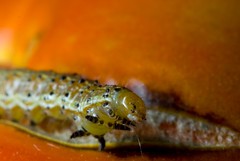
So, I haven't eaten one yet, but if these bastards keep destroying my tomatoes then I'm going to devour each and every last one of them... and hope that they're not toxic. I suppose I'll find out soon enough when I accidentally take a bite out of one lodged firmly in one of my delicious red orbs. I'm typically an insect lover but this pestilent creature has committed a most heinous transgression. This is war.

Helicoverpa zea - tomato fruitworm

Saturday, June 21, 2008

Squid In Ink

Much like my encounter a few weeks ago with the canned octopus, I simply couldn't resist the temptation of this item's visual assault on my eyes as they traversed the many strange items in the latino section of my local Wal-Mart. More important was the disturbing presence of squid ink as a marinade. Conjuring up images of the viscous black fluid I associate with quills and inkwells, I thought for sure this was going to be one disgusting venture.

squid in ink package


The first thing that hit me when I opened the can was not the sickening sight of the squid pieces suspended in what looks like motor oil from a high mileage vehicle but the smell. I enjoy most varieties of fish and other seafood, eating tuna most days out of the week, but this had to be the strongest fishy scent to hit my nose at such a proximity. It was as if an entire fishing wharf had been rendered down into a vile fluid and injected into a can.

squid in ink in can


Somehow growing accustomed to the smell, I moved onto the visual inspection. This simply did not look savory. The squid meat used in this concoction must be from the body of the beast as there was no evidence of tentacles. So I was essentially looking at meat shingles in a vat of tar and contemplating whether or not to stick it in my mouth.

Taking the plunge I was met with a texture and taste unlike any other I have encountered in my previous experiences with squid. The meat was tougher but not as rubbery as from the tentacles and had more of a fishy flavor. I am not sure what notes came from the ink itself as I read on the package that the marinade had been adulterated with tomato sauce, vegetable oil, garlic, and other spices. The taste was not very nice overall but not unpleasant either. I can see that it would go well cooked in something as opposed to being sampled in isolation.

squid in ink close up


Squid in ink is highly disturbing. Most of this is mental but the stench and oiliness are enough to put me off from trying it out of the can again. However, if anyone wants to whip me up a delicious meal using this as an ingredient then I'll be more than willing to give it a second go.

Wednesday, June 18, 2008

Pocket Coffee

With the vast proliferation of hyper-caffeinated foods and beverages over recent years and the popularity of Starbucks and other coffee shops, I'm surprised by the lack of coffee infused chocolates on the US market. There are plenty of coffee flavored chocolates or the occasional chocolate covered espresso bean but there's nothing quite like Ferrero's Pocket Coffee which contains a mini shot of espresso liqueur in a thin sugar shell coated with chocolate.

pocket coffee


As can be expected from European foods, even candies and confections, the flavor is rich but not overly sweet, relying on fat and moderate sugar rather than bucket loads of corn syrup and lacking any hint of artificiality. I tried to gauge the effect of the caffeine content but it was not noticeable. I read that three pieces is equivalent to a shot of espresso so it's clearly not intended to be a stimulant.

pocket coffee ooze


A definite treat for any coffee fiend but good luck finding the stuff and don't expect the same buzz you'd get from caffeine infused "energy" foods.

Saturday, June 14, 2008

Prickly Pear

So I knew that there are some edible cactuses, one of which can provide quite an interesting experience, but I was unaware that there were varieties of cacti that bore fruit.

When I saw the prickly pear, labeled cactus pear, I thought it was just some exotic fruit that, in the manner of some of my recent strange snacks, simply bore resemblance to the plant it was named after. Imagine my shock when I discovered that the prickly pear actually comes from a rather large cactus from the genus Opuntia. This cactus, the Indian Fig Opuntia, is actually quite common across the West and Southwestern regions of the US and much of Mexico.

prickly pear


I chose to eat my prickly pear but it can also be used to make dyes, intoxicants, and for medicinal purposes. Immediately upon slicing the fruit open the usage as a dye becomes evident as the innards are suffuse with a rich maroon liquid much like that fond in beets. The flesh is mildly sweet and has the texture of a grainier canned beet but the flavor more closely resembles a rich watermelon with notes of raspberry. My variety was not seedless so eating it involved taking a spoonful, pushing the flesh through the gaps of my teeth, and spitting out the hordes of ball bearings contained within each bite. Despite the tedious manner of consumption, I quite enjoyed the flavor. Not the cheapest of fruits but more affordable than the typical exotic oddity. Hopefully at least one of these hundred seeds will sprout and I'll get to repeat the experience in about ten years.

prickly pear cut

Tuesday, June 10, 2008

Goat Milk

Up until now, I'd only tried milk from two different creatures: cows, of course, and a human (but I don't remember the experience). I was rather amazed to find that the local Publix sells goat milk and was compelled to immediately buy it, rush home, and pour a glass.

One of my coworkers drank goat milk a lot during his youth and another coworker has had it several times throughout his life. Both reported that it was delicious and sweeter than regular cow's milk. Being that it is an atypical food item I was expecting to encounter a stronger and more distinct flavor on my first sip.

I greatly underestimated the intensity of this "distinct" flavor and my second sip was purely out of incredulity and the inability to stop myself from repeating an experience that has shocked or disgusted me.

I love the taste of lamb and mutton. Goat meat is said to be quite similar in flavor so I could probably expect to enjoy it as well. Despite this, I have never wanted to drink a lamb flavored milkshake but I found myself doing this very thing in my kitchen and the horror of the situation was almost too much for me to handle. My second mouthful and the rest of my glass ended up down the drain and I was left struggling to get the disturbing musky taste out of my mouth.

A far cry from the experience of my coworkers, I found goat milk to be entirely unpalatable and give it the honor of being the most disgusting thing I have consumed so far in the process of creating this diary of strange foods. Now, please excuse me while I go vomit.

goat milk

Saturday, June 7, 2008

Kumquat

The tiny kumquat is the fruit which everybody has heard of but nobody has seen or eaten. The simultaneously exotic and humorous sounding name has given it an almost celebrity level status in the realm of strange food-stuffs in literature, radio, and television but it is nowhere to be seen in local stores and markets.

Within the past few years, after a lifetime of hearing the name, I learned that the kumquat is a small citrus relative so, somewhat accurately, I pictured an orange but on a miniature scale. Thinking more along the lines of a tangerine, I was surprised upon encountering the diminutive kumquat looking like a mad scientist's hybridization of an orange and a grape.

kumquat on the tree


I was afforded the great privilege of pulling one of these delicacies straight from the tree and devouring it on the spot. Unlike its cousins, the kumquat is meant to be eaten whole, skin and all. The skin of most citrus fruits smells incredible and this relative is no exception but, unlike citrus peel, the taste is not incredibly bitter and unpalatable. Perhaps its because the skin is so thin that the bitterness is masked but that lovely scent of citrus peel translates into an incredible tangy, orange-like taste. Combine that with the sweet and sour flesh inside and you have a huge taste sensation in a tiny package. Honestly, this is one of the most fantastic fruits I have ever tasted, so many flavors and so small... nature's perfect candy.

a kumquat in the hand


As luck would have it, we found a seed in one of the kumquats we picked so I'm currently trying to grow myself a tree. Maybe in five years or so I'll be able to again savor the sublime flavor of the kumquat.

Friday, June 6, 2008

Feijoa

The feijoa is a little fruit whose origins are in South America but can be found growing in the Southeastern United States and New Zealand. Despite its tiny size, the feijoa carries a big price tag and if you were to go by smell alone, it would hardly seem worth it. The scent gives a bitter impression and has characteristics notes of unripe or inedible fruits.

fiejoa


However, if you ignore the warning signs of the outer scent and slice it open (in looking at pictures online, slicing it perpendicular to the long side gives a more photogenic view of the innards compared to my lengthwise cut) the aroma becomes more appetizing and noticeably tart. The tartness hits hard upon the initial taste and it like sucking on pure citric acid. The texture is incredibly gritty but not unpalatable and this seems to naturally pair with the tart quality.

Beyond the initial taste and texture shock, the feijoa has a very pleasant flavor which I can't compare to anything else. It is sometimes called a pineapple guava but tastes nothing like either fruit but resembles a miniature version of the latter.

fiejoa cut


While I really enjoyed devouring this little fruit, the price and rarity means that there's not much chance of me making this a regular part of my diet unless, of course, I grew my own... and I just may.

Tuesday, June 3, 2008

Pepino

Because the pepino is very similar in shape, smell, taste, color, texture, and structure to a melon it is often called a pepino melon. But despite so many shared characteristics, the pepino is not closely related to melons at all, the resemblance being another example of evolution arriving at the same general point from disparate paths.

pepino


The pepino is a smooth, white, fist sized, eggplant shaped fruit with thin purple bands running down the skin which are disturbingly reminiscent of stretch marks. It is not often found outside of its native Peru and Chile because it doesn't tend to take transportation well. This is reflected in the $4.99/lb price tag I had to pay for this one and at .59lb, I was out $2.94... a fair price to pay for my innumerable readers (if you don't consider zero a number).

The skin is incredibly thin and the insides are colored with a more off white color. The smell is evocative of a honeydew melon, sweet but somewhat bland and, well, "mellony". The taste, while sweet, is even blander than the scent and, although pleasant overall, there is a slight hint of soapiness.

pepino cut


The rarity of this fruit cannot be attributed solely to its bad reaction to travel. If the typical bland supermarket fruit can beat this little melon mimic then I don't foresee it ever being in high demand.